

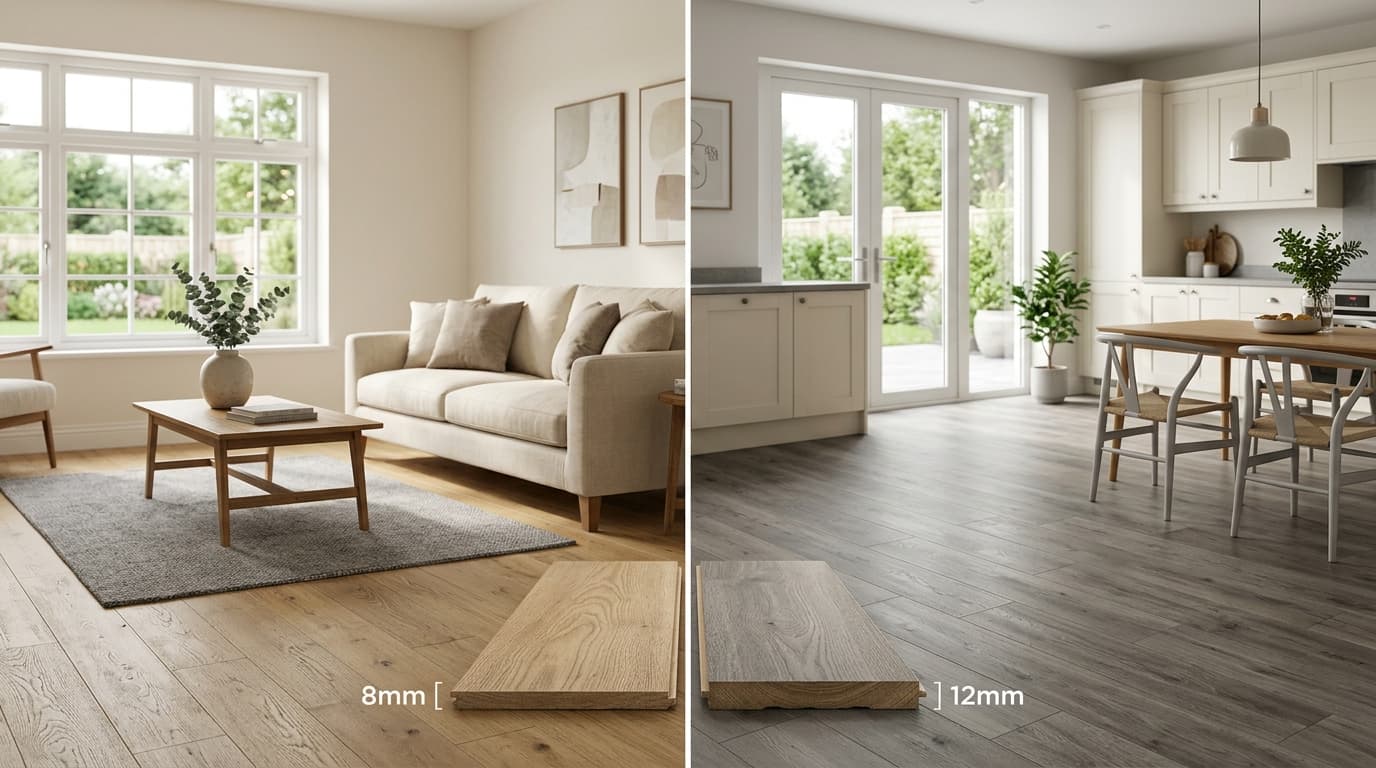
Choosing between 8mm vs 12mm laminate flooring is one of the most common questions we hear at Casey Tiles. On the surface, it seems like a simple numbers game, but the right choice depends on your subfloor condition, room usage, budget, and whether you have underfloor heating. This guide cuts through the confusion so you can buy with confidence.
The thickness measurement refers to the depth of the core board, which is the dense fibreboard layer that gives laminate its rigidity and feel underfoot. A thicker core generally means a more solid feel when you walk on it, better sound absorption, and improved tolerance for minor subfloor imperfections.
It does not refer to the wear layer, which is a separate surface coating rated by AC grades. Thickness and durability are related but not the same thing, and understanding that distinction matters when you are comparing products.
12mm laminate has a noticeably more solid feel. It flexes less, produces less hollow sound when walked on, and generally feels closer to real timber. 8mm is lighter and slightly more flexible, which is not necessarily a problem, but it is more sensitive to what lies beneath it.
This is where the decision often gets made. If your subfloor is level, dry, and in good condition, quality 8mm laminate will perform well and last for years. However, if you are working with an older Irish home where the subfloor is uneven, slightly damp, or showing wear, 12mm is the safer choice. Its thicker core bridges minor dips and irregularities far better, reducing the risk of movement, creaking, or premature wear.
Many homes across Tipperary and throughout Ireland have concrete subfloors that vary in condition. Getting the thickness right from the start saves a lot of hassle down the line.
Laminate flooring is graded using AC ratings that measure resistance to abrasion, impact, and staining. AC4 rated laminate is suitable for heavy domestic use and light commercial settings, and you will find this rating across both 8mm and 12mm products. Thickness alone does not determine durability grade, so always check the AC rating alongside the thickness when comparing options.
For hallways, kitchens, and other high-traffic areas, an AC4 or higher rating matters more than an extra few millimetres of core depth.
Neither 8mm nor 12mm laminate is fully waterproof by default, but many 12mm products include enhanced water-resistant cores and sealed edges that offer better protection against spills and moisture. If you are considering laminate for a kitchen or utility room, look specifically for waterproof laminate flooring options rather than relying on thickness alone as a guide.
For wet rooms, tiles remain the more practical long-term choice. Browse our range of bathroom tiles or kitchen tiles if moisture resistance is a priority in those spaces.
12mm laminate typically costs 30 to 40 percent more than comparable 8mm options. Whether that premium is worth it depends entirely on your situation.
You are likely to benefit from 12mm if your subfloor is imperfect, if the room sees heavy daily foot traffic, or if you want a more premium underfoot feel. For a spare bedroom, a home office, or a room with a solid, level subfloor, good quality 8mm laminate is a perfectly sound choice and will give you excellent results without overspending.
At Casey Tiles, we stock a wide range across both thicknesses, so you can compare options side by side and make a decision based on real product quality rather than guesswork. Keep an eye on our special offers page for current deals on laminate and flooring ranges.
Underfloor heating is increasingly common in new Irish builds, and laminate thickness directly affects how well heat transfers through the floor. Laminate flooring has a thermal resistance value measured in m²K/W. The lower this value, the better the heat transfer.
8mm laminate typically has a lower thermal resistance than 12mm, meaning it conducts heat more efficiently. If underfloor heating performance is important to you, 8mm can actually be the better option, provided your subfloor is in good condition. Always check that the specific product you choose is rated as compatible with underfloor heating systems, and pair it with an appropriate underlay that does not add excessive thermal resistance.
Underlay plays a significant role alongside laminate flooring thickness. A quality underlay improves sound insulation, adds a small amount of cushioning, and helps protect against minor moisture from below. For 8mm laminate, a slightly denser underlay can compensate for the thinner core. For 12mm, a thinner underlay is often sufficient and keeps the total floor build-up manageable.
If underfloor heating is installed, choose an underlay with a combined thermal resistance of no more than 0.15 m²K/W across both the underlay and the laminate itself.
If you love the look of timber but want something more robust in wetter or higher-traffic areas, it is worth considering tiles that look like wood. These give you the warm, natural aesthetic of timber flooring with the durability and water resistance of porcelain or ceramic. They work particularly well in kitchens, hallways, and open-plan living spaces.
For bathrooms, grey bathroom tiles with a wood-effect or stone finish are a popular choice that combines style with practicality. If you prefer something with more character in the kitchen, our patterned kitchen tiles are worth exploring too.
Here is a straightforward summary to help you decide:
In both cases, always prioritise the AC rating and product quality over thickness alone. A well-made 8mm board will outperform a poor-quality 12mm board every time.
Reading about laminate flooring thickness only gets you so far. Walking on both options and seeing the quality in person makes the decision much easier. At our showroom in Cahir, Co. Tipperary, you can browse a wide selection of laminate flooring, timber-effect vinyl, and wooden floors, and our team is always on hand to give you straightforward, practical advice based on your specific room and subfloor.
If you would like to talk through your options before visiting, or if you are based elsewhere in Ireland and want to order online, get in touch with us through our contact page and we will point you in the right direction.